
Archive
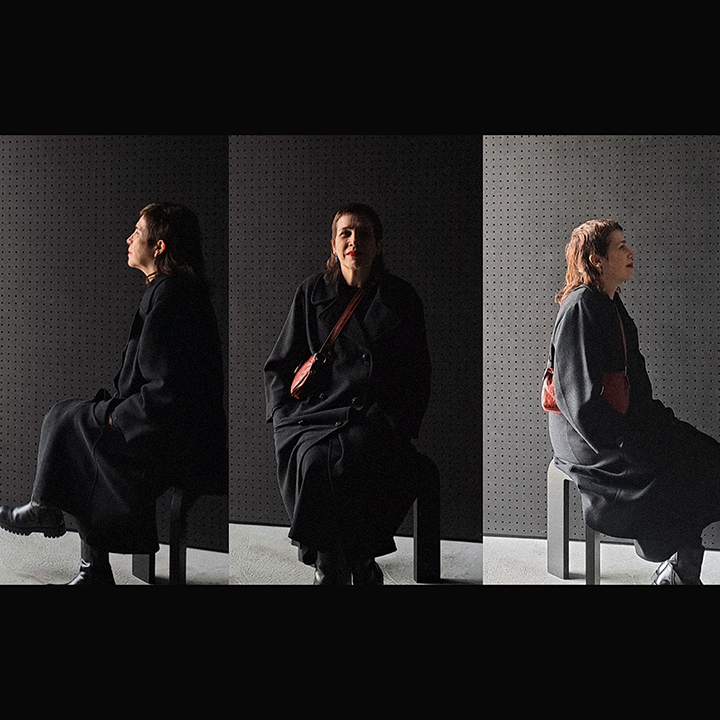
Plural Futures III: Implications
Cristina Janicas
Education, Existence and Freedom
SEMINAR
JUNE 01ST OF 2026, 3PM
ATRIUM BETWEEN BUILDINGS EP1 – ESAD.CR
The Seminar Course of the Industrial Design Bachelor at ESAD.CR returns with a new cycle under the theme Plural Futures III: Implications, proposing a critical immersion into the contemporary conditions of design and the responsibilities that emerge from it.
Starting from the figure of the designer as both a critical subject and a producer of economic, material, and cultural value, this seminar positions itself as a transitional space between academic training and professional practice, questioning how designers act, decide, and position themselves within an
unstable, unequal, and technologically accelerated world.
Organised in an intensive format, with public forums featuring invited guests, the programme brings together different perspectives to discuss what design does and what it implies – across production systems, social structures, economies, and the ways of life it helps to shape.
This cycle proposes to think of design as a situated, political, and ethical practice, capable of anticipating scenarios, challenging established models, and actively participating in the construction of more conscious, sustainable, and plural futures. Between products, brands, systems, and narratives, the seminar establishes itself as a space for listening, confrontation, and critical positioning.
Cristina Janicas
My intervention aims to address the concept of “plural futures” from a philosophical, educational, and existential perspective, arguing that the future is not a single, predetermined destination, but rather an open field of possibilities. Drawing on the existentialist thought of Sartre and the ontology of Heidegger, I will consider education as a situated, dialogical process, deeply connected to human freedom, critical thinking, and creativity.
This intervention seeks to rethink education within a horizon of plural futures – not as preparation for a single predictable outcome, but as the cultivation of the capacity for choice, critical reflection, and humanisation in the face of multiple possible paths.
Within this framework, the role of the teacher is reinterpreted as a mediator of meaning and a co-constructor of knowledge, moving beyond the mere transmission of content to assume an ethical and relational function. Teaching practice is thus understood as a space open to questioning, uncertainty, disobedience, and the shared construction of knowledge.
Cristina Figueiredo Janicas, born on April 10, 1965, holds a degree in Philosophy from the Faculty of Arts and Humanities of the University of Coimbra, and a Master’s degree in Artistic Studies, with a specialization in Cinema.
Within the scope of this Master’s degree, she presented her final dissertation entitled “CineSophia: Cinema and Philosophy. Philosophy in 20 Films.”
In the academic year 2010–2011, she was granted a sabbatical leave by the Ministry of Education to develop an action-research project entitled “CineSophia: Cinema as a pedagogical and didactic tool in the teaching of philosophy.”
Since 1989, she has been a Philosophy teacher in Secondary Education, transforming the classroom into a space for creation and reflection, combining the humanities with the performing arts, visual arts, and cinema. She is currently the coordinator of the School Cultural Plan, a measure of the National Arts Plan, at José Falcão Secondary School.
She has been a member of the governing bodies of Bonifrates – Cooperative for Theatrical Productions and Cultural Activities since 1984, where she has participated as an actress, set designer, and director in several theatrical productions.
As an actress, she has also participated in film projects, namely “Pedro e Inês” by António Ferreira, in 2028, as well as in television projects.
In 2012, she was a jury member of Revista C at the Caminhos do Cinema Português Festival, and in 2016, she served on the jury of the “Outros Olhares” section of the same festival. She was also a jury member at Cinedita – Arganil Short Film Festival in 2017, and at iFive – International School Video Festival in 2023.
In 2025, she was one of the 10 finalists of the 7th edition of the Global Teacher Prize Portugal. In that context, the newspaper Observador published, on July 16, 2025, the article “Images That Think: Philosophy and Cinema in Dialogue”:
https://observador.pt/opiniao/imagens-que–pensam-filosofia-e-cinema-em-dialogo
She was responsible for the artistic direction of several exhibitions at the Exhibition Space of José Falcão Secondary School in Coimbra, among which the following stand out: “Garden of the Revolution”:
https://bienalculturaeducacao.pna.gov.pt/programacao/fichaaberta.php?id=711
“When Absence Screams”:
https://bienalculturaeducacao.pna.gov.pt/programacao/fichaaberta.php?id=712 Both integrated in the Biennial Culture Education #2, in 2025.