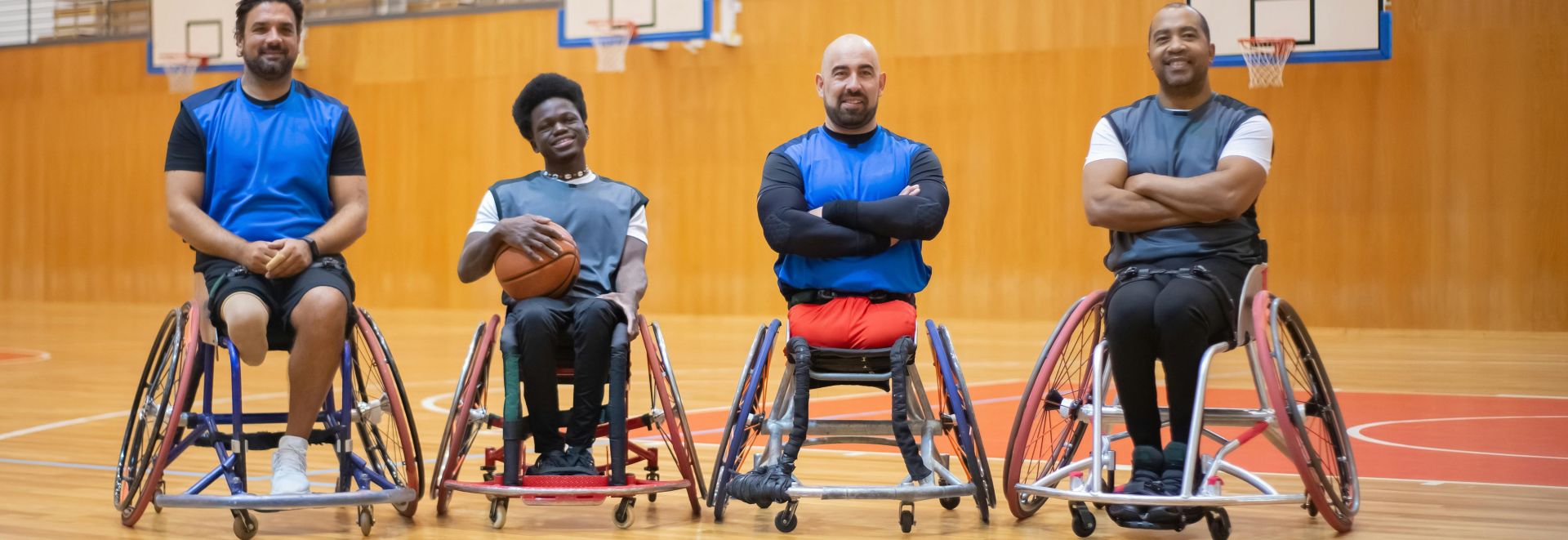
Physical Activity for People with Disabilities
Physical Activity for People with Disabilities
Programme Introduction
The Master’s Degree in Physical Activity for People with Disabilities enables students to deepen their scientific and methodological knowledge in the field of sport and physical exercise specifically tailored to this population. Throughout the programme, students learn to assess needs, design intervention programmes and implement evidence-based practices, promoting inclusion, quality of life and well-being through physical activity.
The programme, embedded within the field of Sport Sciences, provides specialised training focused on functional assessment, exercise prescription, adapted training and the development of projects in sporting, educational and institutional contexts. It fosters the exchange of experiences between students, lecturers and researchers, articulating the acquisition of practice-oriented knowledge with applied research, while encouraging critical thinking, technical autonomy, innovation and ethical responsibility in professional intervention.
Graduates of the programme will be prepared to pursue professional careers in sports clubs and associations, institutions supporting people with disabilities, educational settings and community organisations, as well as to undertake scientific research in the field. With solid preparation aligned with real-world challenges, they will be equipped to contribute actively to increasing and improving participation levels in sport among people with disabilities, establishing themselves as highly qualified professionals in a sector of significant social impact.
Programme Coordinator
(updating)
School
City
Language
Type
Length
Vacancies
General and international Contingent: 25
Notice
Edital 2026 (PT Doc retf)
DGES certification
Objectives
a) Knowledge
Promote the acquisition of knowledge about the characteristics of people with disabilities and intervention through physical activity in
sports, leisure, educational, and institutional contexts, addressing their determinants/benefits.
b) Skills
Foster the ability to critically reflect on the importance of community-based physical activity projects for successful inclusion; develop
skills in autonomous reading, interpretation, scientific writing, and in applying the literature to the design/dissemination of evidencebased
interventions.
c) Competencies
Enable students to assess, prescribe, and implement physical activity practices for people with disabilities in contexts such as clubs,
gyms, institutions, and educational environments; equip them with technical, pedagogical, and didactic competencies to intervene
with a high level of autonomy as coaches, technicians, and health/education professionals, promoting inclusion
Careers Options
- Adapted Sport Technician in sports clubs, associations and federations
- Adapted Sport Coach (foundation, development and high-performance levels)
- Exercise Specialist for Special Populations in gyms and training centres
- Coordinator of Inclusive Physical Activity Programmes in public and private institutions
- Technician in Institutions for People with Disabilities (non-profit organisations, cooperatives, rehabilitation centres)
- Consultant in Sport for Inclusion for local authorities, schools and third-sector organisations
- Researcher in the field of adapted sport and physical exercise for people with disabilities
- Lecturer or vocational trainer in professional and specialised training programmes in the field
| ID | Name | Semester | ECTS | Length |
|---|---|---|---|---|
| Organization of Adapted Sport and Physical Activity | 1S | 5 | 33 h | |
|
||||
| Accessibility and Communication in the Context of Adapted Physical Activity | 1S | 5 | 33 h | |
|
||||
| Foundations of Disability and Adapted Physical Activity | 1S | 5 | 33 h | |
|
||||
| Pedagogy of Sport for People with Disabilities | 1S | 6 | 55 h | |
|
||||
| Exercise Physiology for People with Disabilities | 1S | 6 | 44 h | |
|
||||
| Free Elective I | 1S | 3 | – | |
|
The “Free Elective” unit must be selected from among the curricular units available for this purpose, under the guidance of the higher education institution. |
||||
| Research Methodology | 2S | 6 | 44 h | |
|
||||
| Exercise Prescription for People with Disabilities | 2S | 6 | 44 h | |
|
||||
| Seminar | 2S | 3 | 22 h | |
|
The program of this unit will consist of a series of seminars presented by guest researchers from various national and international institutions, aiming to showcase and discuss recent research in the field of sport applied to people with disabilities. The seminars will be followed by debates actively participated in by the students. Students will also have the opportunity to present their ongoing projects. |
||||
| Community Intervention in Sports and Physical Exercise for People with Disabilities | 2S | 5 | 33 h | |
|
||||
| Sports Training for People with Disabilities | 2S | 7 | 55 h | |
|
||||
| Free Elective II | 2S | 3 | – | |
|
The “Free Elective” unit must be selected from among the curricular units available for this purpose, under the guidance of the higher education institution. |
| ID | Name | Semester | ECTS | Length |
|---|---|---|---|---|
| Dissertation / Project / Internship | Annual | 60 | 6 h | |
|
Dissertation
Project
Internship
|
Entry Requirements
- Holders of a Bachelor’s degree or legal equivalent awarded by a national higher education institution in the areas of Sport Sciences, Health, Education, or other related fields;
- Holders of a foreign higher academic degree, or legal equivalent, awarded following a first cycle of studies organized by the principles of the Bologna Process by a state adhering to this Process, in the fields of Sport Sciences, Health, or related areas;
- Holders of a foreign higher academic degree that is recognized by the Technical-Scientific Council of ESECS as meeting the objectives of a Bachelor’s degree in Sport Sciences, Health, or related areas;
- Individuals with an academic, scientific, or professional curriculum recognized by the Technical-Scientific Council of ESECS as demonstrating the capacity to undertake this cycle of studies.
More information in International Students / Master´s Applications
- Holders of a Bachelor’s degree or legal equivalent awarded by a national higher education institution in the areas of Sport Sciences, Health, Education, or other related fields;
- Holders of a foreign higher academic degree, or legal equivalent, awarded following a first cycle of studies organized by the principles of the Bologna Process by a state adhering to this Process, in the fields of Sport Sciences, Health, or related areas;
- Holders of a foreign higher academic degree that is recognized by the Technical-Scientific Council of ESECS as meeting the objectives of a Bachelor’s degree in Sport Sciences, Health, or related areas;
- Individuals with an academic, scientific, or professional curriculum recognized by the Technical-Scientific Council of ESECS as demonstrating the capacity to undertake this cycle of studies.
More information in International Students / Master´s Applications
Accreditation
State: Accredited
N. years of accreditation: 6
Publication date: 05/12/2025
A3ES Accreditation
State: Accredited
N. years of accreditation: 6
Publication date: 05/12/2025
A3ES Accreditation
More Information
Scientific area of study: CNAEF 0813 Sports – Wellbeing Services
For further information or clarification, please contact:
studywithus@ipleiria.pt or
Raul Antunes
raul.antunes@ipleiria.pt
Scientific area of study: CNAEF 0813 Sports – Wellbeing Services
For further information or clarification, please contact:
studywithus@ipleiria.pt or
Raul Antunes
raul.antunes@ipleiria.pt
Online Application
Use the button bellow to start your application.
Application Fee
60€
60€
Enrolment Fee
General contingent: 50€
International student contingent: 100€
General contingent: 50€
International student contingent: 100€
Tuition Fee
General contingent: 1140€
International student contingent: 3000€
General contingent: 1140€
International student contingent: 3000€