Automotive Engineering

Automotive Engineering

Course Type:
Bachelor’s Programme

Programme Content

Teaching and Learning Philosophy

The foundations of Automotive Engineering in Leiria Polytechnic were set in three main areas: Mechanical Engineering; Electrical Engineering and Management.

The entire curricular plan and subject programs were built on a “hands on” learning philosophy combined with a solid theoretical background support.

All the conventional automotive technologies are addressed side-by-side with state-of-the-art technologies in the field of land mobility. This is only possible in close collaboration with international mobility and companies dedicated to the automotive aftermarket that operate at national level.

Practical learning

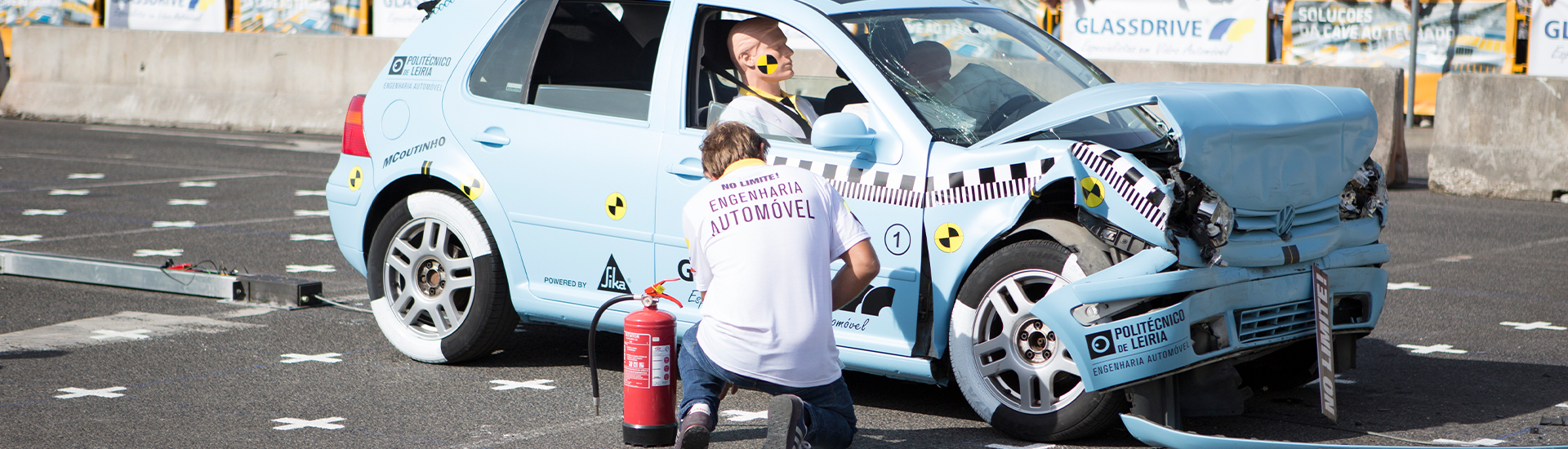
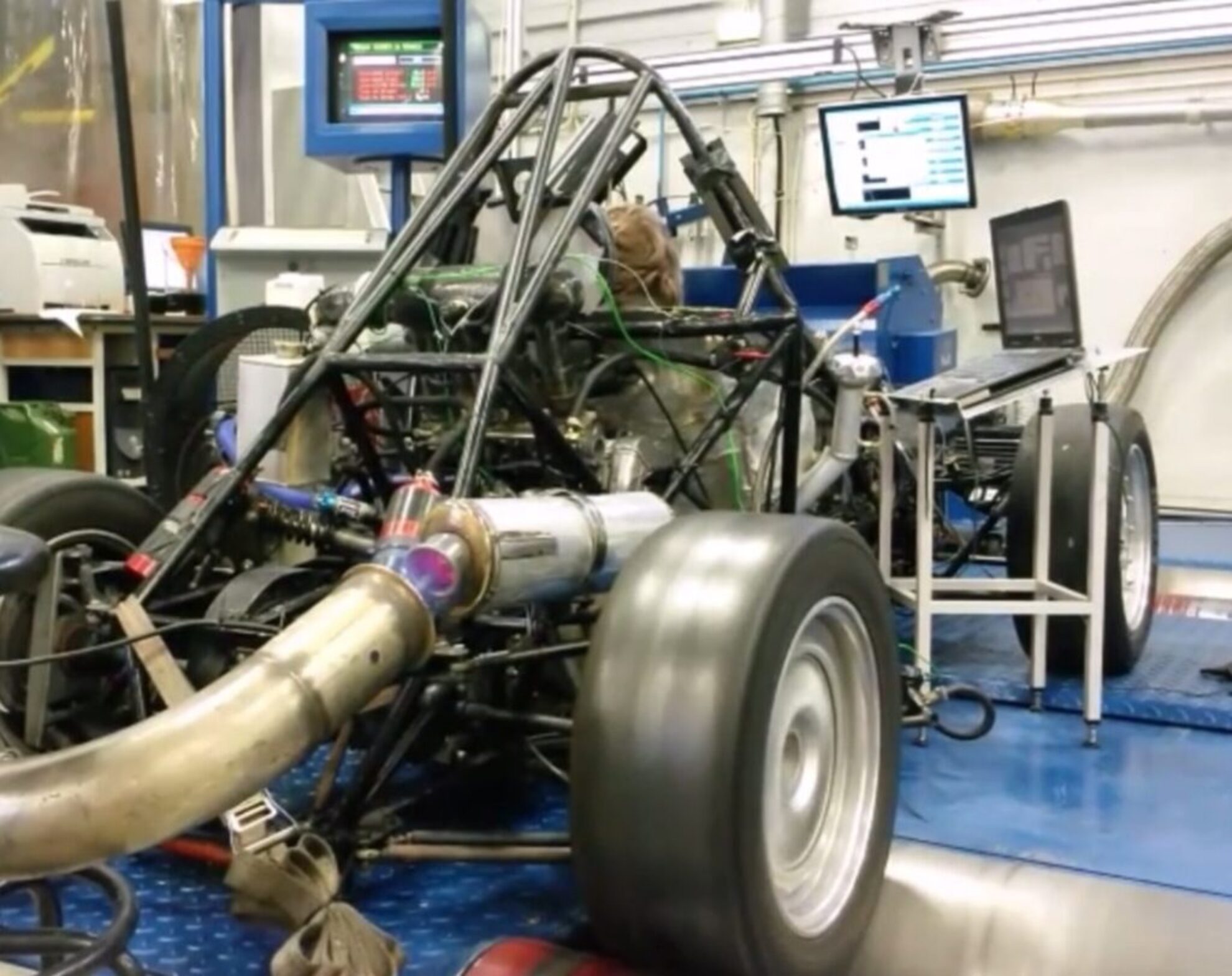
The Automotive Laboratories in Leiria Polytechnic were grouped altogether in a single building forming the biggest and most well-equipped laboratory dedicated to land mobility in Portuguese Polytechnic and University institutions.

These laboratories provide the necessary support for the teaching and learning philosophy that made this graduation the reference in this field among Portuguese Polytechnics and Universities.

Virtual visit to Automotive Laboratory facilities

Programme Coordinator

Paulo Alexandre de Matos e Henriques de Carvalho
coord.eau.estg@ipleiria.pt

Reference

9741

School

City

Language

Portuguese

Type

Morning & Afternoon

Length

6 Semesters

Vacancies

General contingent 40
International student contingent 4

DGES certification
Objectives

Programme

The programme aims to ensure the formation of polyvalent graduates with high scientific, technical, ethical and professional qualification, enabling them to face the diversity of requests made by the automotive sector and will enable them to perform specialized technical functions in companies and entities in that sector of activity, whether services, Commercial or industrial, complemented with cultural, social and ethical values.

The learning objectives respect the methodologies approved by other relevant academia. Namely, an emphasis has been given to the practical character of the curricular units (UC’s) as opposed to a lecture based approach. Moreover, the use of practical laboratory assignments in various UC’s was promoted, as a tool for acquiring skills to apply knowledge, problem solving, gathering information and making judgments, as well as
development of communication and team work skills.

Careers Options

Programme

Automotive Engineering graduates in Leiria have a 96% employability rate.

The knowledge and technical skills showed by Leiria Automotive Engineering graduates are the main key that create a constant flow of employment opportunities available for current students.
1sr Year
ID Name Semester ECTS Length
1st Semester 6 75 h
  1. Differential calculus in IR: Derivative and derivation rules; Derivatives of inverse trigonometric functions; Cauchy’s rule; Higher order derivatives and Taylor polynomial; Parametric curves and derivatives
    2 Integral calculus in IR: Antiderivative and techniques for calculation; Definite integral; Fundamental theorem of integral calculus; Applications (Areas, volumes and arc length of curves)
  2. Functions of several real variables: Definition, domain and graphic representation; Limits and continuity; Partial derivatives and differentiability; Chain rule; Unconstrained extrema
  3. Double integrals: Definition; Fubini theorem; Changing the order of integration; Double integrals in polar coordinates; Applications: computation of areas and volumes
1st Semester 5 60 h
  1. Vectors in R^3: Dot product; Cross product; Scalar triple product.
  2. Matrices and systems of linear equations: Matrix operations; Transpose and inverse of a matrix; Gauss elimination; Rank of a matrix; Systems of linear equations.
  3. Determinants: Techniques for evaluating 2×2 and 3×3 determinants; Properties; Laplace’s theorem (cofactor expansion); Adjoint of a matrix and inverse matrix; Cramer’s rule.
  4. Vector spaces: Properties; Subspaces; Linear combination; Span of a set of vectors; Linear independence; Basis and dimension.
  5. Linear transformations: Matrix of a linear transformation; Kernel and range of a linear transformation; Transformations in the plane; Eigenvalues and eigenvectors.
1st Semester 6 75 h
  1. International system of units; Vectors and scalars; Force and moment.
  2. Systems of forces and equilibrium in two and three dimensions; Free-body diagrams.
  3. Centre of mass and moment of inertia of areas and volumes.
  4. Static friction.
  5. Plane trusses.
  6. Kinematics of particles (Cartesian and polar coordinates): Translation, rotation and plane motion.
  7. Kinetics of particles in translation and in rotation.
1st Semester 6 75 h
  1. Engine repair: Engine disassembly, assembly and tuning techniques; Tools and specific equipment; Engine wear measurement.
  2. Engine auxiliary systems: Intake; Fuel supply; Exhaust; Cooling; Supercharging; Lubrication; Engine electrical systems (starter and battery charging)
  3. Braking, steering and suspension systems components repair and wear measurement techniques.
1st Semester 5 60 h
  1. Atomic structure and bonding.
  2. Materials Science: Metals and metallic alloys; Polymers; Ceramics; Composites
  3. Electrochemistry and corrosion
  4. Mechanical properties of materials and testing.
English 1st Semester 2 30 h
2nd Semester 6 75 h
  1. Number Representation and errors
  2. Nonlinear equations: Root location
  3. Function Approximation: Taylor polynomials; Polynomial interpolation; Least squares method
  4. Numerical integration
  5. Ordinary Differential Equations (ODE): Analytical methods; Numerical methods
  6. Linear programming.
2nd Semester 5 60 h
  1. Algorithms
  2. The C Language
  3. Control statements
  4. Functions
  5. Arrays
  6. Structs; Arrays of structures.
  7. Files: Reading and writing in binary and text files
  8. Passing parameters in the operating system command line
  9. Bitwise operations
2nd Semester 6 75 h
  1. Properties of pure substances.
  2. First Law of Thermodynamics (Closed and open systems).
  3. Second Laws of Thermodynamics – Thermal machines.
  4. Thermodynamic cycles.
  5. Thermodynamics of Combustion.
  6. Fuels – Structure and properties.
2nd Semester 5 75 h
  1. Fundamentals of digital project
  2. Fundamentals of binary numbers
  3. Combinational circuits and their applications
  4. Fundamentals of sequential circuits
  5. Analysis and synthesis of synchronous sequential circuits
  6. Sequential building modules and programmable logic devices
  7. Structured design method for digital systems
2nd Semester 5 60 h
  1. Basic electrical quantities
  2. Measuring instruments
  3. DC circuit analysis
  4. AC circuits analysis
  5. Behaviour of electrical devices in AC and DC
  6. Introduction to three-phase circuits
2nd Semester 3 45 h
  1. Probability distributions: Random variable definition; Discrete random variables; Continuous random variables; Discrete probability distributions; Continuous probability distributions
  2. Summary data analysis: Preparation of a data set; Frequencies distribution tables; Numerical summaries; Graphical representation
  3. Statistical Inference: Point estimation and sampling distributions; Confidence intervals; Hypothesis testing
  4. Bivariate analysis: Contingency tables; Linear Regression
2nd Year
ID Name Semester ECTS Length
1st Semester 4 60 h
  1. Metal Cutting processes: Machining processes (including Computer Numeric Control programming); Blanking and Punching processes.
  2. Metal Forming processes: Forging; Rolling; Extrusion; Deep drawing; Bending.
  3. Equipment for metal forming processes: Hydraulic and mechanical presses; Drop hammers.
  4. Electric Discharge Machining (EDM) and Wire EDM.
  5. Electric arc welding: Shielded metal arc welding; Gas metal arc welding; Gas tungsten arc welding; Plasma arc welding.
  6. Metal Casting: Destructible mould casting (Sand casting; Ceramic-mould casting; Investment casting); Permanent moulding casting (pressure casting, die casting centrifugal casting, continuous casting).
  7. Plastics processing processes: Injection moulding; Powder injection moulding.
1st Semester 5 60 h
  1. Execution of Otto and Diesel cycles.
  2. Engine performance parameters: Torque, Mean effective pressure; Power, Specific fuel consumption.
  3. Engine maps: Performance curve’s analysis; Engine load (Absolute and relative); Load indices; Road load power.
  4. Mechanical efficiency: Indicated and effective values; Engine Friction; Pumping; Auxiliary organs.
  5. Volumetric efficiency: Quasi-static effects; Charge heating; Drop losses; Backflow; Choked flow; Tuning; Ram effect.
  6. Otto engines operation limits: Knock (characterization and prediction); Octane numbers; Ignition mapping;
  7. Diesel ignition delay analysis. Cetane number.
1st Semester 5 60 h
  1. Materials stress: Under general loading conditions; On an oblique plane under axial loading; Components of stress.
  2. Stress and strain under axial loading: Deformations; Statically indeterminate problems; Generalized Hooke’s law.
  3. Torsion: Stress in circular shafts; Angle of twist in the elastic range; Torsion of noncircular members.
  4. Bending: Pure bending; Shear in transverse bending; Deflection of beams.
  5. Möhr´s circle: Transformation of stress.
  6. Yield criteria for ductile and brittle materials.
1st Semester 6 75 h
  1. Definition and properties of a fluid: The Fluid as a Continuum; Density; Viscosities; Shear stress in Newtonian fluids; Nonnewtonian fluids characterization.
  2. Pressure Distribution in a Fluid: Pressure and Pressure Gradient; Gage Pressure and Vacuum Pressure; Hydrostatic pressure distribution; Applications in manometry; Hydrostatic forces on planar surfaces; Hydrostatic forces on curved surfaces; Hydrostatic forces in layered fluids.
  3. Integral Relations for a Control Volume: Frictionless Flow (Bernoulli Equation).
  4. Viscous Flow in Ducts: Reynolds-Number; Flow regimes; Flow in a circular pipe; Moody chart; Minor Losses in pipes; Flow in noncircular ducts; Hydraulic power of pumps and turbines.
1st Semester 5 75 h
  1. Semiconductor devices: Diodes; Bipolar transistor; Field effect transistor (MOSFET); Insulated Gate Bipolar Transistor; Automotive applications.
  2. Sensors: Classification, characteristics and calibration; Physical principles of transduction; Automotive applications.
  3. Signal conditioning: Resistance to voltage conversion; Operational amplifiers; Circuits with operational amplifiers; Adaptation of impedances; Differential amplifier and instrumentation amplifier; Comparator circuit with hysteresis; Filters.
  4. Integrated circuits: Instrumentation amplifiers; Optocouplers; Voltage comparators; Linear voltage regulators; Integrated oscillators; Automotive applications.
1st Semester 5 60 h
  1. Orthographic Projections; Cuts and sections; Perspectives.
  2. Technical drawing dimensioning and tolerancing; Indication of surface states.
  3. Computer aided design in 3-D solid modelling: Parametric Modelling; Assembly modelling and functional motion analysis.
2nd Semester 5 60 h
  1. Processors and computer architectures.
  2. Microprocessor instructions set and programming.
  3. Memory: Types of memory in the microcontroller.
  4. Auxiliary circuits and I/O peripherals: Interrupts; Timers, counters and comparators; A/D and D/A converters; Synchronous and Asynchronous communications.
  5. System design controlled by a microcontroller: Programming and development tools; Project methodology.
2nd Semester 6 75 h
  1. Dimensional Analysis and Similarity Laws: Dimensions and Units; Dimensional Analyses; Similarity Laws
  2. Turbo machines; Laws of conservation; Performance; Engine supercharging.
  3. Aerodynamics; Laws of mass, momentum and energy; Flow field around an object; Aerodynamic coefficients based on the flow field; Numerical (CFD) prediction of the flow field around an object; Aerodynamics of road vehicles.
2nd Semester 5 60 h
  1. Static design: Torsion and bending; Stress concentration;
  2. Fatigue design: Fatigue process; Fluctuating stresses; Fatigue tests; S-N diagram; Endurance-limit modifying factors; Fatigue strength under fluctuating stresses.
  3. Rolling bearings: Hertz contact stresses; Rolling bearing types and load; Rolling bearing life; Lubrication, assembling and maintenance.
  4. Welded joints: Types of joints; Calculation of welded joints.
  5. Design of screws: Thread standards and definitions; Mechanics of power screws; Thread stresses and fasteners; Bolted joints in tension; Strength specifications; Shear of bolts due to eccentric loading; Keys and pins.
2nd Semester 4 60 h
  1. Physical mechanisms of heat transfer: Conduction, Convection and Thermal radiation; Thermal
    properties
  2. One dimensional heat conduction in steady state
  3. Transient heat transfer
  4. Fins
  5. Forced convection
  6. Heat exchangers: Classification, DTML and e-NTU methods
  7. Convection.
2nd Semester 4 60 h
  1. Electric and hybrid vehicles: Subsystems and components; Architectures; Network and control systems in electric traction; Operating cycle characteristics of Hybrid Vehicles (HEV) and Battery Charging Hybrid Vehicles (PHEV)
  2. Electrical, electromagnetic, and electromechanical principles: Electromagnetism; Electromechanical Energy Conversion; Rotating electrical machines; Torque/speed and power/speed characteristic curves
  3. Electric machines applied to traction: Classic DC machine; Brushless DC machine (BLDC); Asynchronous or induction machine; Permanent magnet or coiled synchronous machine; Switched reluctance machine
2nd Semester 6 75 h
  1. Engine mechanical management systems: Ignition; Air fuel mixture; Fuel injection
  2. Engine electronic control systems: Electronic ignition; Electronic injection on gasoline engines; Diesel injection
  3. Engine advanced testing and repair technics: Dynamometer engine testing; Engine components repair
  4. Surface treatment and repainting: Tools, products and facilities; Application techniques; Colour identification; Paint quality control; Cost assessment.
3rd Year
ID Name Semester ECTS Length
1st Semester 5 60 h
  1. Fluid power in automotive and industrial applications.
  2. Design and modelling of vehicle chassis systems: Braking Systems; Hydraulic and pneumatic brake circuits; Suspension and steering systems; Interference between suspension, braking and steering.
  3. Operational analysis of active vehicle chassis systems: Brake control systems (ABS/EBS); Stability control systems (ESP/DSC); Traction control systems (ASR/TCS).
1st Semester 5 75 h
  1. Functional analysis and kinematics of drivetrain systems: Flexible; Gear driven; Single disc and multidisc clutches, dry and wet; Gearboxes (Manual, Automatic, Continuous variable); Hydraulic transmissions; Torque converters; Transfer cases, differentials, self-locking systems.
  2. Repair techniques, fault diagnosis and operation of automotive drivetrain: Gearboxes (Manual, Automatic, continuous variable, transfer boxes); Clutches (Single disc and multidisc, dry and wet); Differentials (Differential and open self-locking systems); Shafts and shaft couplings; Flexible transmissions.
  3. Drivetrain selection: Vehicle drivetrain design; Transmission diagrams.
1st Semester 6 75 h
  1. Finite element method (FEM): FEM based on displacement formulation; Principle of minimum potential energy; Application on static and dynamic domains; Finite element networks; Interpolation functions; Dynamics in FEM; Commercial applications.
  2. Advanced materials mechanics: Laminated composite; Static and dynamic loading in vehicles; Repair processes and tridimensional analysis.
1st Semester 5 60 h
  1. Battery fundaments. Types of electrochemical cells.
  2. Automotive battery applications: Plomb batteries; Lithium batteries.
  3. Fuel cells.
  4. Battery Management Systems.
  5. Electrical Safety. Emergency in electrified vehicles.
  6. Vehicle charging infrastructures.
1st Semester 5 60 h
  1. Operating Systems (OS) and Real Time Operating Systems (RTOS): OS-less and OS embedded systems; Embedded systems and processors architecture.
  2. Real-time operating systems in computationally constrained microprocessors: Critical Sections in RTOS; Task Management; Scheduling; Context change, interruptions management, time management and resource Management in RTOS; Synchronization; Messages.
  3. Signal processing and real time analysis: Communication between processes and devices; Interfaces management input / output; Realtime operation and control of physical systems; Realtime operating system (FreeRTOS); Laboratory project for knowledge application.
1st Semester 4 60 h
  1. Quality Management in the automotive industry: Principles; Quality tools; Trends and challenges.
  2. Quality Management Systems (QMS): Implementation of a QMS; The European Foundation for Quality Management (EFQM) excellence model; Family of standards ISO 9000 (Standard NP EN ISO 9001: 2015); IATF 16949:2016 (Quality management systems for organizations in the automotive industry).
  3. Methodologies to support the design and planning of products and services: Fundamentals; Failure mode, effects & criticality analysis (FMECA); Quality Function Development (QFD).
2nd Semester 12 15 h

This subject acts as an integrator of the knowledge acquired in different areas along the graduation.
It allows the development of skills and knowledge consolidation through the development of an engineering project on automotive or mobility applications.

2nd Semester 6 75 h
  1. Automotive diagnosis: On-board and Off-board diagnosis; Diagnosis tools and equipment.
  2. Diagnostic techniques and processes.
  3. Diagnostic of automotive components: Sensors and Actuators
  4. Waveform analysis.
  5. Diagnostic in automotive systems: Electrical and electronic; Engine electronic management on Otto and Diesel engines; Braking and active safety systems; Exhaust and emissions control; Comfort and passive safety; Mechanical systems.
2nd Semester 4 45 h
  1. Companies: Management; Objectives; Life cycle and legal forms
  2. The internal entrepreneur: Continuous improvement; Innovation management
  3. Opportunities and ideas: Sources of ideas; Creativity; Testing ideas
  4. Strategy: Analysis; Formulation; Implementation; Assessment and control
  5. Marketing and Sales: Segmentation, targeting and positioning; Digital Marketing; Marketing plan implementation; Commercial management
  6. Leadership and ethics: Importance and impact; Business and professional ethics
  7. Team management: People; Team goals
  8. Intellectual Property
  9. Innovation projects.
2nd Semester 4 60 h
  1. Car maintenance and industrial maintenance
  2. Organization and planning of an automotive maintenance service
  3. Reliability and availability of a vehicle or a machine
  4. Maintenance costs
  5. Automotive warranties and claims
  6. The inventory management in a car service
  7. The client and the relationship with the car service company
  8. Legal concepts and liability
  9. Commercial concepts associated to the maintenance service.
2nd Semester 4 60 h
  1. Engineering of Vehicle dynamics: Vehicle Modelling for Planar Dynamics; Vehicle dynamics in crash; Kinematic and dynamic analysis applied to multibody systems; Vehicle standard regulations
  2. Automotive Safety: Accident prevention techniques; Passive and active safety systems

Entry Requirements

For further information about international students’ applications,
please see International Applicants
or contact the International Students’ Office by email at: estudante.internacional@ipleiria.pt

Accreditation

State: Accredited
Number of years of accreditation: 6
Publication Date: 04/12/2020
A3ES Accreditation

Online Application

Use the button bellow to start your application.

Application Fee

60€

Enrolment Fee

General contingent: 30€
International student contingent: 100€

Tuition Fee

General contingent: 697 €
International student contingent: 3000€