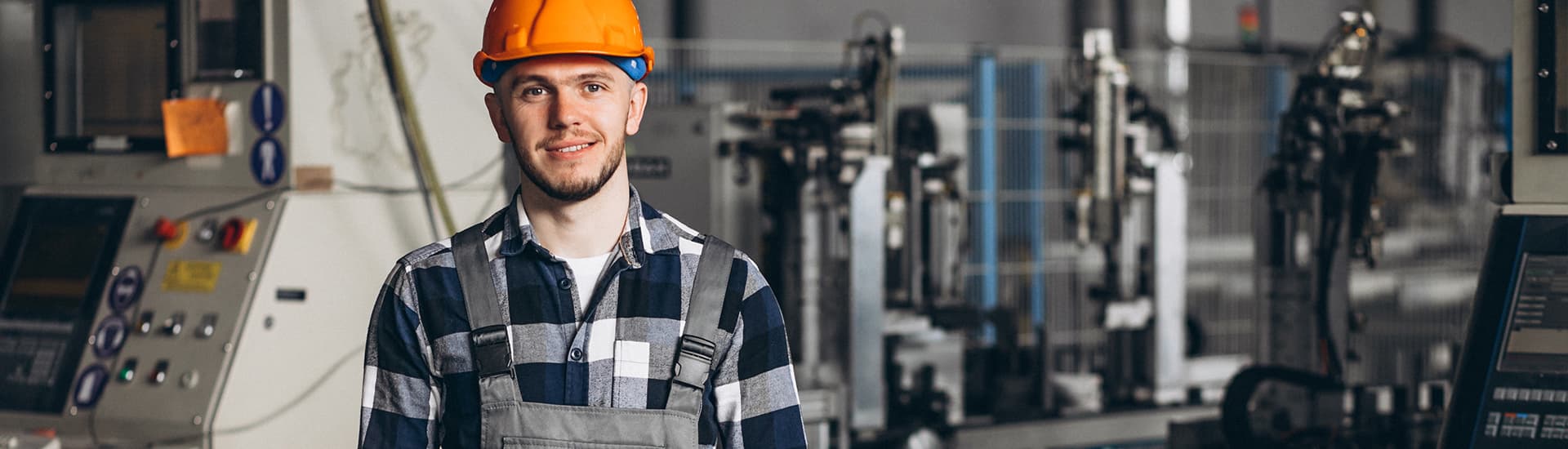
Industrial Engineering and Management

Industrial Engineering and Management

Course Type:
Bachelor’s Programme

Programme Introduction

The Bachelor’s Degree in Industrial Engineering and Management highlights the added value of combining engineering and management education, preparing professionals capable of designing, managing and improving production and organisational systems in increasingly demanding and dynamic industrial, national and international contexts.

The structure of the programme allows students to build a differentiated academic pathway through elective course units. This approach enables the development of competencies in complementary areas such as information systems, computer-aided manufacturing, accounting, or innovation and entrepreneurship, without compromising the strength of the core education in industrial engineering and management. Graduates are therefore equipped to optimise resource utilisation and manage business processes in an effective, integrated and innovative manner.

Programme Coordinator

Irene Sofia Carvalho Ferreira
coord.egi.estg@ipleiria.pt

Reference

9104

School

City

Language

Portuguese

Type

Morning & Afternoon

Length

6 Semesters

Vacancies

General contingent 20
International student contingent 5

DGES certification

Objectives

Programme
  • Analyse, design and optimise production and organisational systems;
  • Develop decision-making skills supported by quantitative methods and engineering tools;
  • Promote the application of efficiency, quality, innovation and sustainability principles in industrial and service contexts;
  • Use technologies supporting production, information and management;
  • Foster teamwork, communication and leadership skills in multidisciplinary environments;
  • Encourage adaptability to different sectors of activity, based on a flexible and practice-oriented education.
  • Process Engineer
  • Production Engineer
  • Production Planning and Control Technician
  • Operations Manager
  • Logistics and Supply Chain Technician
  • Process Improvement and Continuous Improvement Consultant
  • Quality Technician
  • Industrial Project Manager
  • Industrial Information Systems Technician

1st Year
ID Name Semester ECTS Length
1st Semester 6 75 h
  1. SI unit system. Scalar and vector quantities.
  2. Linear and angular kinematic quantities.
  3. Forces and Newton’s Laws. Translational static equilibrium in two- and three-dimensional systems.
  4. Moment of inertia. Moment of a force. Equivalent systems of forces.
  5. Translational and rotational static equilibrium, in two and three dimensions, of rigid bodies.
  6. 2-D lattice structures.
  7. Friction force.
  8. Centroids
1st Semester 6 75 h
  1. Introduction to computation and programming;
  2. Basic stages to develop programs – Algorithms.
  3. Introduction the language Python.
  4. Python objects. Data, Types, Operations, Expressions, I/O instructions, …
  5. Control statements (if; for; while).
  6. Modules (definition and importing).
  7. Data structures.
  8. Input/Output communication.
  9. Graphical environments
1st Semester 6 75 h

1 Differential calculus in IR
1.1 Notion of derivative, derivation rules
1.2 Derivatives of inverse trigonometric functions
1.3 Cauchy’s rule
1.4 Higher order derivatives and Taylor polynomial
1.5 Parametric curves and derivatives
2 Integral calculus in IR
2.1 Antiderivative and techniques for calculating primitive functions
2.2 Definite integral
2.3 Fundamental theorem of integral calculus
2.4 Applications: computation of areas, volumes and arc length of curves
3 Functions of several real variables
3.1 Definition, domain and graphic representation
3.2 Limits and continuity
3.3 Partial derivatives and differentiability
3.4 Directional derivatives
3.5 Chain rule
3.6 Unconstrained extrema
4.Double integrals
4.1. Definition
4.2. Fubini’s theorem
4.3. Changing the order of integration
4.4. Double integrals in polar coordinates
4.5. Applications

1st Semester 5 60 h
  1. Basic concepts
    1.1. Economic science: object and method
    1.2. Economy Compartments
  2. Economic problem
    2.1. Scarcity and Choice
    2.2. Opportunity cost
    2.3. Production possibilities frontier
  3. National accounting:
    3.1. Basic concepts.
    3.2. Economic circuit.
    3.3. Product measurement: the different optics.
  4. The Market: Demand and Supply
    4.1. Demand
    4.2. Supply
    4.3. Equilibrium
    4.4. Elasticities
    4.5. State intervention
  5. Consumer theory
    5.1. Budget Restriction
    5.2. Consumer preferences
    5.3. The demand curve
  6. Producer theory
    6.1. Production and productive factors
    6.2. The supply curve
1st Semester 5 60 h
  1. Vectors in R^3
    1.1 Dot product
    1.2 Cross product
    1.3 Scalar triple product
  2. Matrices and Systems of Linear Equations
    2.1 Matrix definitions and examples
    2.2 Matrix operations
    2.3 Transpose and inverse of a matrix
    2.4 Gauss elimination
    2.5 Rank of a matrix
    2.6 Systems of linear equations
  3. Determinants
    3.1 Definition
    3.2 Techniques for evaluating 2×2 and 3×3 determinants
    3.3 Properties
    3.4 Laplace’s theorem (cofactor expansion)
    3.5 Adjoint of a matrix and inverse matrix
    3.6 Cramer’s rule
  4. Vector spaces
    4.1 Definition and examples
    4.2 Properties
    4.3 Subspaces
    4.4 Linear combination
    4.5 Span of a set of vectors
    4.6 Linear independence
    4.7 Basis and dimension
  5. Linear transformations
    5.1 Definition and examples
    5.2 Matrix of a linear transformation
    5.3 Kernel and range of a linear transformation
    5.4 Linear transformations in the plane
    5.5 Eigenvalues and eigenvectors
1st Semester 2

English

  1. English as a lingua franca. Attitudes towards English.Expressions to convey linguistic and learning necessities.Brief notions of the characteristics that have led English to become a global language.
  2. Informal Conversation: Taking part in conversations about people, places and other topics; description of personal and professional profiles; identification of cultural differences.
  3. Contacts: Starting and keeping conversations about topics related to the professional context via telephone, email. Describing people and exchanging information.
  4. Meetings: Expressions to set up and organize meetings, make decisions, solve problems, present suggestions and lead meetings. Official register of information. Checking and clarifying facts and figures.
  5. Negotiating relationships: Expression of formality and informality. Expression of likes and dislikes about travelling on business. Discussing attitudes about meetings and cultural behaviours in different countries.

Free Elective

The “Free elective” curricular unit must be selected from among the curricular units offered across all ESTG degree programmes and made available for this purpose, under the guidance of the higher education institution.

2nd Semester 5 60 h
  1. General aspects of technical drawing
    1.1 normalized writing, types of lines and sheet design.
    1.2 Subtitles and scales
  2. Orthogonal projections
    2.1 Types of projections, views and select the required front view.
    2.2 Views displaced, local, discontinued, detail and auxiliary.
  3. Sectional
    3.1 Standards
    3.2 Types of sections
  4. Perspectives
    4.1 Standards and types of perspective
    4.2 Construction of objects in perspective
    4.3 Cuts and dimensioning in perspective
  5. Dimensioning
    5.1 Elements and general aspects
    5.2 Types and rules of dimensioning.
  6. Dimensional tolerances and surface states
    6.1 Standards and definitions
    6.2 Tolerance fits.
    6.3 Dimensional control.
    6.4 Definitions and symbols in the representation of surface states.
    6.5 Roughness
  7. Introduction to assembly drawing
  8. Introduction to computer-aided design
2nd Semester 5 75 h
  1. Numerical methods
    1.1. Theory of errors (absolute error, relative error, correct decimal places, significant digits, floating-point number representation)
    1.2. Numerical resolution of equations and systems of non-linear equations (bisection and Newton methods and convergence)
    1.3. Approximation of real functions (Taylor’s formula, polynomial interpolation (direct, inverse, and Hermite), and least squares method)
    1.4. Numerical integration (Newton-Cotes and Gauss-Legendre formulas)
    1.5. Ordinary Differential Equations (ODE): analytical and numerical resolution of ODE of 1st order and higher order (Euler, Runge-Kutta
    methods)
  2. Linear programming
    2.1 Graphic method and the Simplex method
2nd Semester 6 75 h
  1. Kinematics of rigid bodies
    1.1. Rectilinear and curvilinear motion
    1.2. Rotational movement around a fixed axis
    1.3. Plane curvilinear motion
  2. Dynamics of rigid bodies
    2.1. Rectilinear and curvilinear motion
    2.2. Rotational movement around a fixed axis
    2.3. Plane curvilinear motion
    2.4. Modeling and simulation in Scilab/Xcos of a simple dynamic system
  3. Mechanisms
    3.1. Degrees of freedom and classification of mechanisms
    3.2. Study of various types of mechanisms
    3.3. Modeling and simulation in Scilab/Xcos of a simple mechanism
  4. Mechanical vibrations of the particle and the rigid body
    4.1. Free, linear and angular vibrations (undamped and damped)
    4.2. Forced vibrations and resonance
2nd Semester 5 45 h
  1. Introduction to Industrial Engineering;
  2. Tipos de layouts;
  3. Functional areas:
    3.1 Management;
    3.2 Product Development;
    3.3 Planning;
    3.4 Shopping;
    3.5 Production;
    3.6 Quality Management;
    3.7 Maintenance Management;
    3.8 Health and Safety;
    3.9 Logistics;
    3:10 Sales and Marketing
2nd Semester 6 75 h

Theoretical Teaching

  1. Atomic Structure and Bonding
  2. Introduction to Materials Science
    2.1. Metals and Metallic Alloys
    2.2. Polymers
    2.3. Ceramics
    2.4. Composites
    Theoretical and Practical Teaching
  3. Electrochemistry
  4. Materials Corrosion
  5. Mechanical Properties of Materials and Mechanical Tests
    Practical and Laboratorial Teaching
  6. Laboratory: material, equipment and safety
  7. Execution/Demonstration of laboratory experiments
2nd Semester 3 45 h

1 Probability distributions
1.1 Random variable definition
1.2 Discrete random variables
1.3 Continuous random variables
1.4 Discrete probability distributions (Bernoulli trials, binomial and Poisson)
1.5 Continuous probability distributions (uniform, exponential and normal)
2.Summary data analysis
2.1 Preparation of a data set
2.2 Frequencies distribution tables
2.3 Numerical summaries (central and not central tendency, dispersion, skewness and outliers)
2.4 Graphical representation

3.Statistical Inference
3.1 Point and interval estimation
3.2 Confidence intervals
3.3 Hypothesis testing

4.Bivariate analysis
4.1 Contingency tables
4.2 Linear Regression

2nd Year
ID Name Semester ECTS Length
1st Semester 5 60 h

1 – Stress (mechanics) definition:
1.1. Analysis of simple structures;
1.2. Stresses on an oblique plane under the action of axial load;
1.3. Stress tensor.

  1. Axial loading:
    2.1. Deformation;
    2.2. Statically indeterminate problems;
    2.3. Thermal variation problems;
    2.4. Multiaxial loads; generalised Hooke’s law;
    2.5. 2D Mohr’s circle.
  2. Torsion (mechanics):
    3.1. Deformation of a circular bar;
    3.2. Stresses in a circular bar; Torsion angle;
    3.3. Torsion of non-circular cross-sections;
  3. Bending (mechanics):
    4.1. Pure/transversal bending;
    4.2. Equation of the elastic line;
    4.3. Eccentric bending;
    4.4. Eccentric (load) tensile/compression;
    4.5. Stress due to combined loading.
1st Semester 5 60 h
  1. Process Design
    1.1 Types of Processes;
    1.2 Lean Manufacturing;
    1.3 Flow Analysis.
  2. Process Management
    2.1 Inventory Management;
    2.2 MRP1 and MRP2;
    2.3 Scheduling of Operations;
    2.4 Project Management.
1st Semester 5 60 h

1 – Introduction to manufacturing processes
2 – Forming processes
2.1 – Forging
2.2 – Rolling
2.3 – Extrusion
2.4 – Sheet metal forming
2.5 – Bending.
3 – Cutting processes
3.1 – Sheet shearing. Progressive tooling.
3.2 – Chip metal cutting. Computer numeric control.
4 – Equipment for forming processes
4.1 – Hydraulic and mechanical presses. Drop hammers.
5 – Electric discharge machining
5.1 – Wire and Ram EDM.
6 – Electric arc welding
6.1 – Manual metal arc, MIG/MAG, TIG and Plasma.
7 – Casting
7.1 – Casting in destructible mouldin

1st Semester 5 60 h
  1. Thermodynamics – Fundamentals;
  2. Power Cycles;
  3. Fluid Mechanics – Fundamentals;
  4. Incompressible Viscous Flow;
  5. Heat Transfer – Fundamentals;
1st Semester 5

Computer-Assisted Manufacturing and Project

Theoretical-Practical (TP) Teaching:

  1. Learning in a digital world
  2. Introduction to PFAC
  3. Integration of communication devices in products
  4. CAD/CAM/CAE applications
  5. CAD modeling
  6. Native and neutral files in CAD
  7. Feature-based, associative, and parametric modeling
  8. Computer Graphics
  9. Reverse Engineering
  10. Human-machine interaction, collaborative robotics integrated with CAM
  11. Numerical Control and CNC Machines
  12. Numerical Control Machines
  13. CNC Programming
  14. CAD/CAM/CAE Integration
  15. CAM Applications
  16. CAM Generation and Verification
  17. CAPP
  18. Introduction to PIC
  19. Prototyping/Rapid Manufacturing/FDD:
    Practical and Laboratory Teaching (P):
  20. Components and Assemblies in CAD
  21. File Import/Export
  22. CAD/CAM/CAE Integration
  23. CNC Machining
  24. CAM Machining
  25. Reverse Engineering
  26. Prototyping/Rapid Manufacturing/FDD

Free Elective

The “Free elective” curricular unit must be selected from among the curricular units offered across all ESTG degree programmes and made available for this purpose, under the guidance of the higher education institution.

1st Semester 5

Accounting

  1. The nature of the business process and the role of accounting
  2. Management accounting
  3. Financial accounting: general aspects
  4. Financial accounting: the various cycles of business operations
  5. Financial accounting: the rendering of accounts

Free Elective

The “Free elective” curricular unit must be selected from among the curricular units offered across all ESTG degree programmes and made available for this purpose, under the guidance of the higher education institution.

2nd Semester 5 60 h

1 – Design for static strength
2 – Design for fatigue strength
3 – Welded joints
4 – Design of screws
5 – Mechanical springs
6 – Rolling Bearings
7 – Flexible mechanical transmissions
8 – Gears transmissions

2nd Semester 5 60 h

1.Introduction.
2.Electric circuits elements.
3.Direct current circuits
4.Steady state, alternating current circuits
5.Brief introduction to electromechanics
6.Industrial electronics
7.Human and equipment safety

2nd Semester 6 60 h
  1. Waiting queues;
  2. Simulation
  3. Mixed Integer Programming;
  4. Multi-objective Programming;
  5. Network Optimization;
  6. Project Management.
2nd Semester 4 45 h
  1. Introduction
  2. Financial Analysis instruments
  3. Financial Analysis methods and techniques
  4. Analysis of Financial Equilibrium
  5. Risk Analysis
  6. Performance Analysis
  7. Activity and Growth Analyses
2nd Semester 5 60 h
  1. Polymeric materials
  2. Processing of polymeric materials
  3. Ceramics materials
  4. Processing of ceramic materials
  5. Powder metallurgy
  6. Composites materials
  7. Processing of composite materials
  8. Additive Manufacturing
2nd Semester 5 60 h
  1. Introduction to Maintenance Management
  2. Maintenance Service Organization
  3. Reliability, Maneuverability and Availability
  4. Reliability and Availability of Systems
  5. Maintenance Costs
  6. Total Productive Maintenance
  7. Introduction to Condition Control
3rd Year
ID Name Semester ECTS Length
1st Semester 5 60 h

1.Introduction to Industrial Logistics;
2.Aggregate Supply Chain Planning;
3.Supply Chain Transport Management;
4.Procurement and Supply Management;
5.Demand Management – Forecasting Methods;
6.Supply Chain Storage and Stock Management;
7.Logistics and Supply Chain Information Systems;
8.Decision Models and Coordination in Supply Chains.

1st Semester 4 60 h
  1. Basic concepts of Financial Mathematics and Accounting
  2. Introductotion to Investment Project Analysis
  3. Relevant information in investment project evaluation
  4. Evaluation methods of investment projects
  5. Selection of mutually exclusive investment projects
  6. Project financing
  7. Project analysis under uncertainty
1st Semester 5 60 h

Pneumatics;
o Basic principles,
o Production and processing of compressed air,
o Pneumatic symbols,
o Actuators and valves,
o Circuit analysis.
Oil-hydraulics;
o Basic principles,
o Oil-hydraulics symbols,
o Pumps, motors, linear actuators and valves,
o Hydraulic fluids, types and characteristics,
o Circuit analysis.
Process automation
o Basic principles ,
o functional levels of an automated system,
o Process functional specification,
o Architecture of Programmable Logic Controllers (PLC),
o PLC programming methods,
o Characteristics and operation of PLC.

1st Semester 5 60 h
  1. Introduction to Quality Management: Total Quality Management, Continuous Improvement in Organizations, Kaizen, Lean / Six Sigma, New Challenges for Quality Management;
  2. Methodologies to support the Design and Planning of Products and Services: QFD, FMEA, New Trends in Product and Service Development;
  3. Accreditation and Certification of systems and products: NP EN ISO 9001:2015.
  4. Quality Tools: 7 Basic Tools, A3 and 8D.
1st Semester 7 60 h

Based on the integrated work objectives, the syllabus will be defined based on the adoption of the following work methodology:

  1. Selection and description of the final product;
  2. Determination of production capacity and cycle time of the production unit;
  3. Study of the assembly process and definition of assembly sequence of components / subassemblies;
  4. Analysis / subcontracting of production of parts and components;
  5. Study of the production process, technology selection and definition of the manufacturing range of the produced components;
  6. Analysis of methods and time of production and assembly;
  7. Analysis of the needs for productive resources and space;
  8. Balancing assembly lines;
  9. Selection of transportation equipment and material handling;
  10. Material flow analysis and factory layout;
    11.Process cost analysis.
4

Information Systems

  1. The Digital Organization
    1.1. Classification of Information Systems (IS)
    1.2. Functional perspective, the strategic and business process integration
  2. Support Systems and Organizational Management
    2.1. Supply Chain Management (SCM)
    2.2. Customer Relationship Management (CRM)
    2.3. Knowledge Management Systems (KMS)
  3. Implementation of Information Systems
    3.1. Role of the IS in the strategy of organizations
    3.2. Techniques and analysis tools
    3.3. Reengineering of business processes
    3.4. implementation
    3.5. Verification & Validation
    3.6. Conversion strategies
  4. Management Information Systems
    4.1. Perception and evaluation of the value of investments in IS
    4.2. Traditional models and strategic
    4.3. The problem of interoperability
    4.4. Benchmarking – Performance evaluation; Standards and quality metrics applied to benchmarking, analysis of results
    4.5 Change Management

Free Elective

The “Free elective” curricular unit must be selected from among the curricular units offered across all ESTG degree programmes and made available for this purpose, under the guidance of the higher education institution.

2nd Semester 4 45 h
  1. Fundamental concepts of marketing
  2. Market analysis
  3. Market studies
  4. STP model: Segmentation, Targeting and Positioning.
  5. Marketing mix
2nd Semester 3 45 h

1 National and world energy scenario
1.1 Energy and environment
1.2 Energy policies
2 Demand Side Management (DSM)
2.1 Goals of DSM
2.2 Load diagram changes
2.3 Resources and actions on offer side
2.4 Resources and actions on demand side
2.5 Planning and implementation of DSM actions
2.6 Energy tariffs
3 Energy audit
3.1 Objectives of the audit
3.2 Types of energy audit
3.3 Planning and implementation an audit
3.4 Equipments used on an audit
4 Efficient use of energy (EUE) and energy conservation opportunities (ECO)
4.1 Economical analysis
4.2 ECOs in lighting
4.3 ECOs in electromechanical drives
4.4 ECOs in other end uses
5 National regulation on energy
6 Environmental management
7 Strategic waste management

2nd Semester 3 45 h
  1. Human Capital Management:
    1.1 Recruitment, Selection and Professional Integration; ·
    1.2 Performance Appraisal;
    1.3 Training and human resources development.
  2. Orgnizational Behaviour:
    2.1 Team work;
    2.2 Leadership;
    2.3 Motivation
2nd Semester 2

Innovation and Entrepreneurship

  1. Introduction to Entrepreneurship Innovation (types, motivation, culture)
  2. Opportunities and ideas
    2.1. Sources of ideas
    2.2. Creativity
    2.3. Innovation
  3. The internal entrepreneur
    3.1 Testing ideas (Proposition Value Canvas)
    3.2 Business test (Business Model Canvas)
  4. Team and project management
  5. Intellectual property
  6. Financing
  7. Organizational management and business plan
    7.1. Business strategy
    7.2. Marketing strategy
    7.3. Business plan

Free Elective

The “Free elective” curricular unit must be selected from among the curricular units offered across all ESTG degree programmes and made available for this purpose, under the guidance of the higher education institution.

2nd Semester 18

Industrial Project II

The syllabus covered will be defined based on guidelines established for each project to develop

Internship

The internship syllabus will be defined for each specific case taking into account the type of company or institution and the specific area where the internship will take place.
The internship plan of this UC will be defined by the responsible teacher(s) together with the host company, aiming to solve concrete problems by applying the knowledge acquired during the degree in Engineering and Industrial Management. Internship themes proposed by students may be considered as long as they fit the UC objectives. It is also intended with the UC the
preparation and presentation of a final report that describes the activities and conclusions of the work developed.


Entry Requirements

For further information about international students’ applications,
please see International Applicants
or contact the International Students’ Office by email at:
studywithus@ipleiria.pt

Accreditation

State: Accredited
Number of years of accreditation: 6
Publication Date: 30/03/2026
A3ES Accreditation

Online Application

Use the button bellow to start your application.

Application Fee

60€

Enrolment Fee

General contingent 30€
International student contingent 100€

Tuition Fee

General contingent: 697 €
International student contingent: 3000€