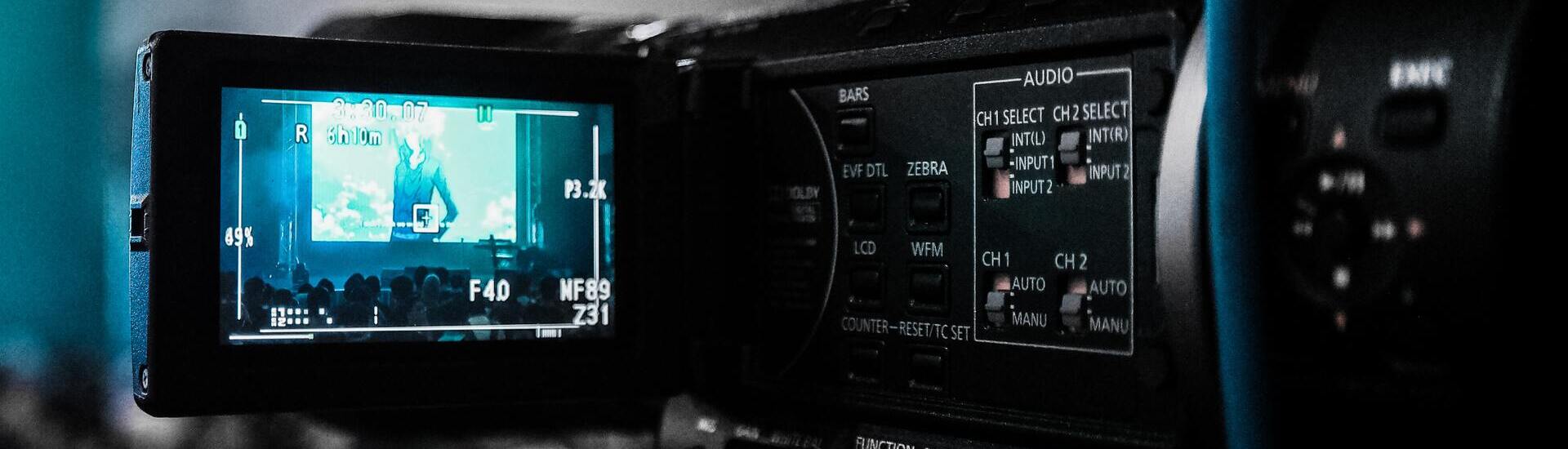
Communication and Media
Communication and Media
Programme Introduction
The Master’s degree in Communication and Media aims to provide graduates with an integrated set of dynamic skills, firmly grounded in knowledge and skills of advanced level of understanding in the scientific area of Communication Sciences. This course intends, on one hand, the formation of versatile professionals in the area of the different types of communication, with communicational and technological skills, and secondly, to enhance the learning of scientific knowledge in the field of communication sciences. Thus, one of its goals is to seek answers to the new challenges that present themselves to the different valences and professional environments where communication takes leading role, requiring a new action based on criteria of efficiency and productivity, and identify lines of research relevant to the scientific development of this subject area.
Programme Coordinator
Marco José Marques Gomes Alves Gomes
marco.gomes@ipleiria.pt
Reference
School
City
Language
Type
Length
Vacancies
General and International student contingent: 25
Notice
Edital 2026 (PT Doc retf)
DGES certification

Objectives
- The main guidelines of the syllabus are rooted in the development of scientific and technical skills of professional advanced level:
- Analyze different perspectives on the development of the relationship established between the Communication, the Media and Marketing;
- Acquire knowledge adjusted to the activities of Communication and Media in different professional environments;
- Establish goals and set policies for their planning and implementation of practical and theoretical contexts;
- Using the tools available and adjusted to the full exercise of the activity, with the competences and vocation the company/organization;
- Understand the role of Media in the society and in corporate and business communications, and how to organize and develop communication products;
- Recognize the contribution to lifelong learning, adaptability and integration of professionals, with the inherent strengthening of employability at local, regional, national and European level.
| ID | Name | Semester | ECTS | Length |
|---|---|---|---|---|
| Organizational Behavior and Internal Communications | 1st Semester | 6 | 38h | |
|
1.Do marketing transacional ao marketing relacional |
||||
| Global Information Dynamics and Proximity Journalism | 1st Semester | 6 | 38h | |
|
||||
| Brands and Communication Management | 1st Semester | 6 | 38h | |
| Media, Communication and Press Office | 1st Semester | 6 | 38h | |
|
Module 1. |
||||
| Projeto de Design e Produção Digital | 1st Semester | 6 | 38h | |
| Communication and Relationship Marketing | 2nd Semester | 6 | 38h | |
| Management, Business and Entrepreneurship in Communication | 2nd Semester | 6 | 38h | |
|
I |
||||
| Emerging Technologies Lab | 2nd Semester | 6 | 38h | |
| Research Methods in Social Sciences and Communication | 2nd Semester | 6 | 38h | |
|
||||
| Networks and Digital Communities | 2nd Semester | 6 | 38h | |
|
| ID | Name | Semester | ECTS | Length |
|---|---|---|---|---|
| Seminar | 1st Semester | 15 | 42h | |
| Project / Dissertation / Internship | 2nd Semester | 45 | ||
|
Entry Requirements
- Holders of an undergraduate degree in the areas of Management, Communication, Human Resources and other areas directly related to this study cycle;
- Holders of foreign academic degree of a 1st study cycle organized according the principles of the Bologna Process offered by a State that has adhered to this Process, in the area mentioned in paragraph a);
- Holders of foreign academic degree recognized by the scientific body of the establishment of higher education as an undergraduate degree, as long as it is in the area mentioned in paragraph a);
- Holders of an educational, scientific or professional curriculum, recognized as attesting the capacity to carry out this cycle of studies by competent scientific body of the establishment of higher education (subparagraph d)) of paragraph 1 of article 17 of the Decree Law 74/2006, of 24 March, with changes introduced in subsequent normative).
International Student
All information related to the international student application should be consulted on our International Students webpage.
- Holders of an undergraduate degree in the areas of Management, Communication, Human Resources and other areas directly related to this study cycle;
- Holders of foreign academic degree of a 1st study cycle organized according the principles of the Bologna Process offered by a State that has adhered to this Process, in the area mentioned in paragraph a);
- Holders of foreign academic degree recognized by the scientific body of the establishment of higher education as an undergraduate degree, as long as it is in the area mentioned in paragraph a);
- Holders of an educational, scientific or professional curriculum, recognized as attesting the capacity to carry out this cycle of studies by competent scientific body of the establishment of higher education (subparagraph d)) of paragraph 1 of article 17 of the Decree Law 74/2006, of 24 March, with changes introduced in subsequent normative).
International Student
All information related to the international student application should be consulted on our International Students webpage.
Accreditation
State: Accredited
Number of years of accreditation: 6
Publication Date: 20-12-2024
Accreditation A3ES
State: Accredited
Number of years of accreditation: 6
Publication Date: 20-12-2024
Accreditation A3ES
More Information
Observations
The study cycle will have duration of 4 semesters and has been structured in the following manner:
The 1st semester comprises 4 curricular units, for a total of 30 credits;
The 2nd semester has a total of 4 curricular units and 30 credits;
In the 3rd semester, students perform the curricular unit Seminar with 15 credits and initiates the development
of the CU Project, which should be completed in the 4th semester (30 credits).
Contacts
E-mail: studywithus@ipleiria.pt
Observations
The study cycle will have duration of 4 semesters and has been structured in the following manner:
The 1st semester comprises 4 curricular units, for a total of 30 credits;
The 2nd semester has a total of 4 curricular units and 30 credits;
In the 3rd semester, students perform the curricular unit Seminar with 15 credits and initiates the development
of the CU Project, which should be completed in the 4th semester (30 credits).
Contacts
E-mail: studywithus@ipleiria.pt
Application Fee
60€
Enrolment Fee
General contingent: 50€
International student contingent: 100€
General contingent: 50€
International student contingent: 100€
Tuition Fee
General contingent: 1140€
International student contingent: 3000€
General contingent: 1140€
International student contingent: 3000€
Online Application
Use the button bellow to start your application.